The Terrifying Noise: Why Your AC Suddenly Stopped Cooling
Experiencing the buzzing outdoor unit: diagnosing a blown AC capacitor during a Roanoke heatwave begins with a problem our team at Woods Family Heating & Air Conditioning knows all too well. Especially in late August, just as families are transitioning back to school and the end-of-summer heat feels unrelenting, you might walk outside on a sweltering afternoon because the house feels uncomfortably warm, only to be greeted by a loud, aggressive mechanical noise from your outdoor equipment. The air coming from your indoor vents is lukewarm, the thermostat reading is slowly climbing, and your outdoor condenser is emitting a loud buzzing or humming without fan movement. In our experience, this specific, alarming sound usually points to a single electrical component failing rather than the entire air conditioning system dying. Recognizing this noise means the system is actively drawing power from your electrical panel but failing to actually start the cooling cycle.
If your outdoor AC unit is buzzing and the fan is not spinning, it is likely a blown run capacitor. Turn off your AC at the thermostat immediately to prevent severe damage to your compressor, then call a professional HVAC technician to safely diagnose and resolve the issue.
If you need immediate help, reach out for professional HVAC services or schedule an air conditioning repair to protect your equipment and restore your home's comfort.
What is an AC Capacitor and Why Does It Buzz?
When our technicians arrive to investigate this aggressive noise, we often start by explaining the electrical demands of your outdoor condenser. The compressor and the fan motor require a massive amount of energy to start moving—often three to five times their normal running current. Your home's standard electrical supply cannot deliver that sudden surge of power fast enough. That is where the run capacitor comes in. It acts as a high-voltage, heavy-duty battery that stores electricity and releases it in a powerful jolt to get the motors spinning.
The Electrical Jolt Your Compressor Needs
Most modern residential air conditioning systems use a dual run capacitor. This small, cylindrical, metal component sits inside the electrical panel of your outdoor unit and serves two distinct motors: the compressor (which pumps the refrigerant) and the condenser fan (which blows heat away from the unit). When the thermostat calls for cooling, the capacitor discharges its stored energy to overcome the resting inertia of these heavy mechanical parts. Over time, the internal components of the capacitor degrade, losing their ability to store and release that necessary microfarad charge.
The Source of the Buzzing Sound
When a capacitor blows or fails, the motors still receive the signal and the baseline voltage from your home's electrical panel to turn on. However, without the massive starting jolt from the capacitor, they lack the torque to actually begin spinning. This creates a condition known as a "locked rotor state." The loud buzzing or humming you hear is the physical sound of raw electrical current dead-ending into a stationary, struggling motor. The fan blade remains completely still while the unit vibrates with trapped electrical energy. Before assuming the worst, understanding how to reset your air conditioning unit can sometimes clear minor electrical glitches, but a persistent buzz almost always points to a failed capacitor.
• Loud buzzing, fan blade stationary — Likely Component Issue: Blown run capacitor or seized fan motor — Immediate Action Required: Turn off thermostat immediately
• Repeated clicking from outdoor unit — Likely Component Issue: Failing contactor relay — Immediate Action Required: Turn off power, call professional
• High-pitched squealing — Likely Component Issue: Worn fan motor bearings or compressor issue — Immediate Action Required: Shut down system to prevent damage
• Humming from indoor air handler — Likely Component Issue: Indoor blower motor or transformer issue — Immediate Action Required: Turn off system, inspect indoor unit
How Roanoke's Extreme Summer Weather Pushes Capacitors to the Brink
Heat is the primary enemy of all electrical capacitors. Inside the metal casing of a capacitor is a specialized dielectric fluid or oil that helps regulate temperature and store energy. When subjected to extreme temperatures, this internal fluid begins to degrade, expand, and eventually fail. During an August late-summer heatwave, the metal cabinet of your outdoor condenser sits in direct sunlight, baking the electrical components inside. When you combine the ambient outdoor temperature with the internal heat generated by the running motors, the environment inside that electrical panel becomes incredibly hostile.
Roanoke's specific summer climate adds another layer of stress to these components. The region is known for high humidity levels, which forces your air conditioning system to run in extended, continuous cycles just to wring the moisture out of the indoor air before it can effectively lower the temperature. These long, continuous cycles prevent the condenser unit from cooling down between runs. The capacitor is constantly discharging and recharging without a break, trapping heat inside the electrical panel until the component finally exceeds its thermal limits and bulges or pops.
One Roanoke homeowner recently reached out to us when their air conditioning was not cooling properly during a stretch of particularly hot weather. One of our technicians arrived, checked the whole system, and explained the process of how severe heat impacts these aging electrical components. By understanding the regional climate factors, our technician was able to quickly swap the swollen component and ensure the customer was cool again. We see these failures peak late in the season when components have endured months of thermal stress.
• Ambient heat load: Direct sunlight bakes the metal condenser cabinet, raising the baseline temperature of the electrical panel.
• Extended run times: High humidity forces the system to run constantly, preventing the capacitor from cooling down.
• Thermal expansion: The internal oils boil and expand, causing the top of the capacitor to bulge outward.
• End-of-season fatigue: Months of heavy use leave older components vulnerable to sudden failure during late-summer spikes.
The Immediate Danger: Why You Must Shut Off Your Thermostat
When you hear that aggressive buzzing sound, your air conditioning system is actively in danger. Leaving a buzzing unit turned on will cause the compressor to overheat rapidly. A locked compressor draws massive amounts of amperage—far more than it is designed to handle for more than a fraction of a second. If left in this state, the excessive electrical draw can melt internal wiring, damage the contactor, and eventually burn out the compressor motor entirely. A simple electrical repair can quickly escalate into a catastrophic system replacement if the unit is not shut down.
We had another local customer call us on a Sunday with an urgent need when their air conditioning stopped working completely and began humming. Our on-call technician called back quickly, arrived within an hour, and had the air conditioning working again within minutes precisely because the homeowner had recognized the danger and safely turned the system off, preventing irreversible damage to the compressor. If you hear this noise, you must take immediate action to protect your equipment.
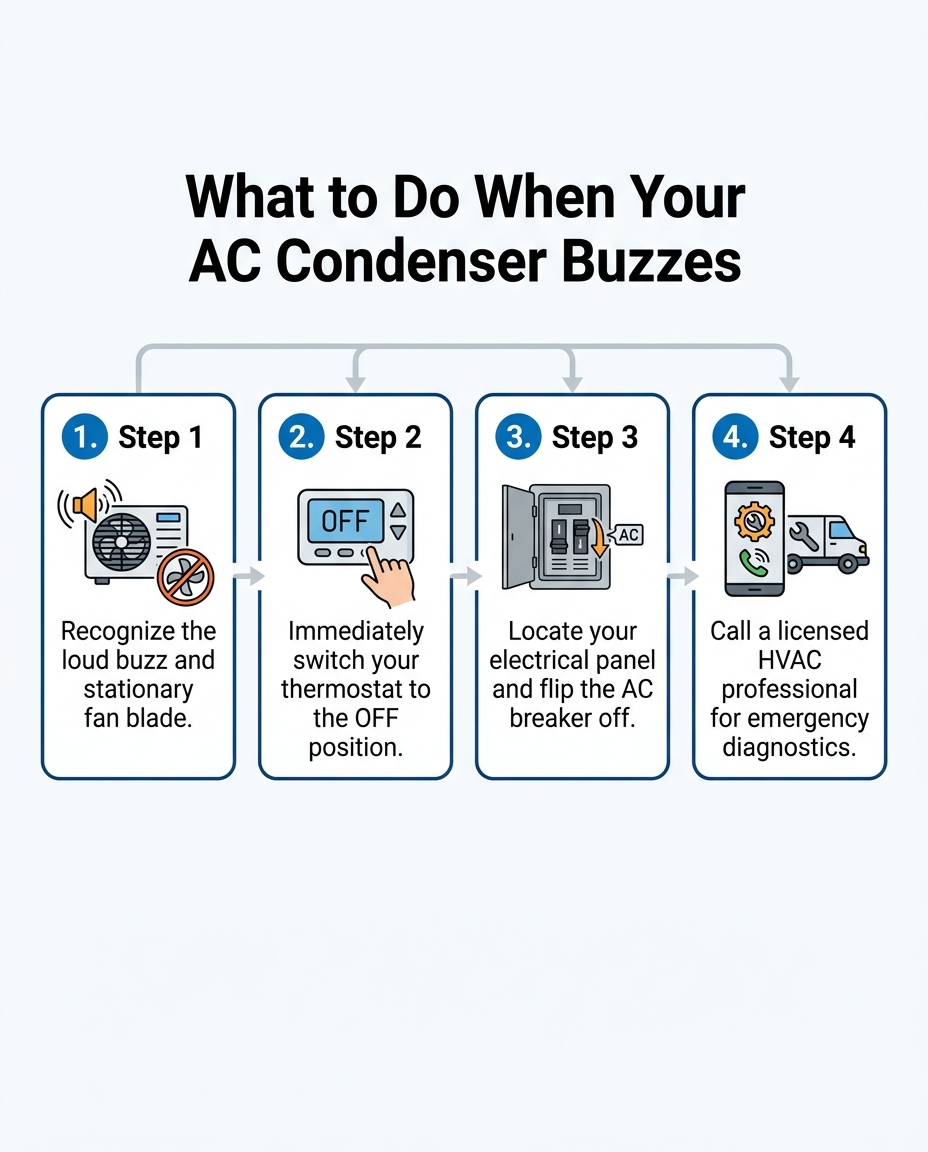
1. Switch the thermostat to OFF: Go to your indoor thermostat immediately and switch the cooling cycle completely off. Do not just raise the temperature; ensure the system is physically switched to the "OFF" position.
2. Turn off the breaker: For added safety, locate your home's main electrical panel and flip the dedicated breaker for the air conditioner to the off position.
3. Do not force the fan: Never attempt to push the fan blade with a stick or your fingers to get it started.
4. Call for help: Once the system is safely depowered, it is time to schedule an AC repair with a licensed professional.

Why Capacitor Replacement is Strictly a Professional Job
While identifying a buzzing capacitor is straightforward, replacing one is strictly a job for a licensed HVAC professional. Capacitors are designed to store lethal amounts of high-voltage electricity, and they retain this charge even after the power to the unit has been turned off at the main breaker. Touching the wrong terminals on a capacitor can result in a severe, potentially fatal electrical shock. Professionals use insulated tools and specific procedures to safely discharge the stored energy before they ever attempt to remove the component.
Furthermore, safely testing and replacing a capacitor requires specialized diagnostic tools. A standard voltage meter is not enough; technicians use multimeters equipped with specific capacitance settings to measure the microfarads and determine if the component has failed or if the issue lies deeper within the compressor. Internet "hacks" like pushing the fan blade with a stick to jump-start the motor are incredibly dangerous. Not only can this result in lost fingers if the blade suddenly engages, but it also forces the compressor to run without its necessary starting torque, which can cause permanent internal motor damage.
Finally, a licensed HVAC technician ensures that the replacement capacitor matches the exact microfarad specifications of your specific system. Installing an incorrectly sized capacitor will cause the motors to run hot, significantly reducing the lifespan of your condenser fan and compressor. Professional installation guarantees that the electrical load is balanced and the system operates safely.
Rapid Diagnostics: Getting Your Home Cool Again
Hearing a loud mechanical buzz from your air conditioner is stressful, but a professional diagnostic visit can resolve the issue quickly and safely. When a technician arrives at your home, they will perform a comprehensive evaluation of the outdoor unit. This involves safely discharging the old dual run capacitor, testing the contactor relay for pitted or burned wiring, and inspecting the fan motor bearings for signs of wear. They do not just swap the part; they ensure that the failed capacitor did not cause secondary damage to the surrounding electrical components.
A trained professional will also check for underlying issues that may have caused the capacitor to fail prematurely. If your condenser coils are caked in dirt and debris, the system cannot exhaust heat efficiently, which bakes the electrical panel and destroys capacitors. At Woods Family Heating & Air Conditioning, our local experts have spent years diagnosing these exact end-of-season failures. We provide rapid, professional diagnostics and reliable repairs that prioritize restoring your comfort quickly during intense Roanoke heatwaves. We carry a wide inventory of OEM and universal capacitors on our trucks to ensure we can get your system back online in a single visit.
The best way to avoid a sudden breakdown during a heatwave is through proactive care. Enrolling in a preventative maintenance plan allows our technicians to test the microfarad readings of your capacitor during the spring. If the readings are dropping or the top of the casing is beginning to bulge, we can replace the weak component long before it leaves you stranded with a buzzing unit on a hot August afternoon.
Frequently Asked Questions About Buzzing AC Units
Why is my AC unit buzzing but the fan is not turning?
It is most likely a blown run capacitor. The run capacitor provides the massive electrical jolt required to start the heavy fan motor and compressor. When it fails, the motor still receives baseline electricity from the house but lacks the stored energy to actually begin spinning. The buzzing sound is the electrical current vibrating against the stationary motor.
Can a bad capacitor cause a buzzing sound?
Yes, it is the most common cause of a loud buzz from the outdoor condenser. The buzz is the sound of the compressor and fan motor struggling to start in a locked rotor state. Because the motors cannot overcome their resting inertia without the capacitor's help, they simply vibrate and hum loudly as they draw excessive amperage.
Is a buzzing AC unit dangerous?
It is highly dangerous to the AC equipment, though rarely a fire hazard if your home's circuit breakers function correctly. Leaving a buzzing unit running will cause the compressor to overheat rapidly as it pulls locked rotor amps. If you do not shut the system off, the intense heat will eventually melt the internal wiring and permanently destroy the expensive compressor motor.
What happens if you run an AC with a bad capacitor?
The system will pull excessive amperage, trip the circuit breaker, or burn out the compressor motor. The equipment is not designed to handle the massive electrical draw of a stalled motor for more than a few seconds. You must turn the thermostat to the "OFF" position immediately to prevent catastrophic mechanical failure.
How long does it take a professional to replace a capacitor?
Once diagnosed, a professional technician can safely replace a capacitor in under an hour. Because this is one of the most common electrical failures during extreme weather, professionals carry a wide variety of universal and OEM capacitors on their trucks. This allows them to perform rapid heatwave repairs and restore your cooling during the same visit.
Restoring Comfort When the Roanoke Heat Peaks
A buzzing outdoor unit is a loud, unmistakable cry for help from a struggling air conditioning system. If you hear this noise, validating the symptom and taking quick action to turn off the system at the thermostat is the most important step you can take to save your expensive compressor from permanent damage. While the sound is terrifying, the solution is usually a straightforward professional electrical repair.
Do not let a failed component leave your family sweating through the worst of the late-summer heat. By relying on our local experts to safely diagnose the electrical issue, you can avoid the dangers of high-voltage repairs and get your system running efficiently again. Reach out for an air conditioning repair today to restore your home's comfort and protect your equipment for the rest of the season.